
.png)
Most conversations about software for rehab centers focus narrowly on alumni management or discharge planning. But forward-thinking providers are starting to look beyond isolated tools and toward fully integrated rehab operations systems that support the entire patient journey (from intake to long-term engagement) on a single connected platform.
Today, with the advancement of technology, this isn’t really a pipe dream. In fact, it’s exactly what modern integrated platforms make possible. And treatment centers that embrace this approach are seeing measurable improvements in outcomes, staff efficiency, and reimbursement rates.
Here’s what it looks like in practice, and how to evaluate whether your current software setup is holding you back.
The Problem With Fragmented Software for Rehab Centers
The average behavioral health provider uses multiple disconnected tools: one for clinical documentation, another for scheduling, a third for billing, and maybe a spreadsheet or email system for alumni follow-up. Every handoff between systems is a potential failure point.
Fragmented rehab center management software creates real consequences, and these include the following:
- Clinical teams waste hours re-entering data across platforms
- Aftercare plans get created in treatment and are never followed up on
- Alumni fall through the cracks between discharge and formal follow-up
- Outcomes data is scattered, making it difficult to report to insurers or accreditors
- Staff burnout increases as the administrative burden grows
What Integrated Software for Rehab Centers Actually Looks Like
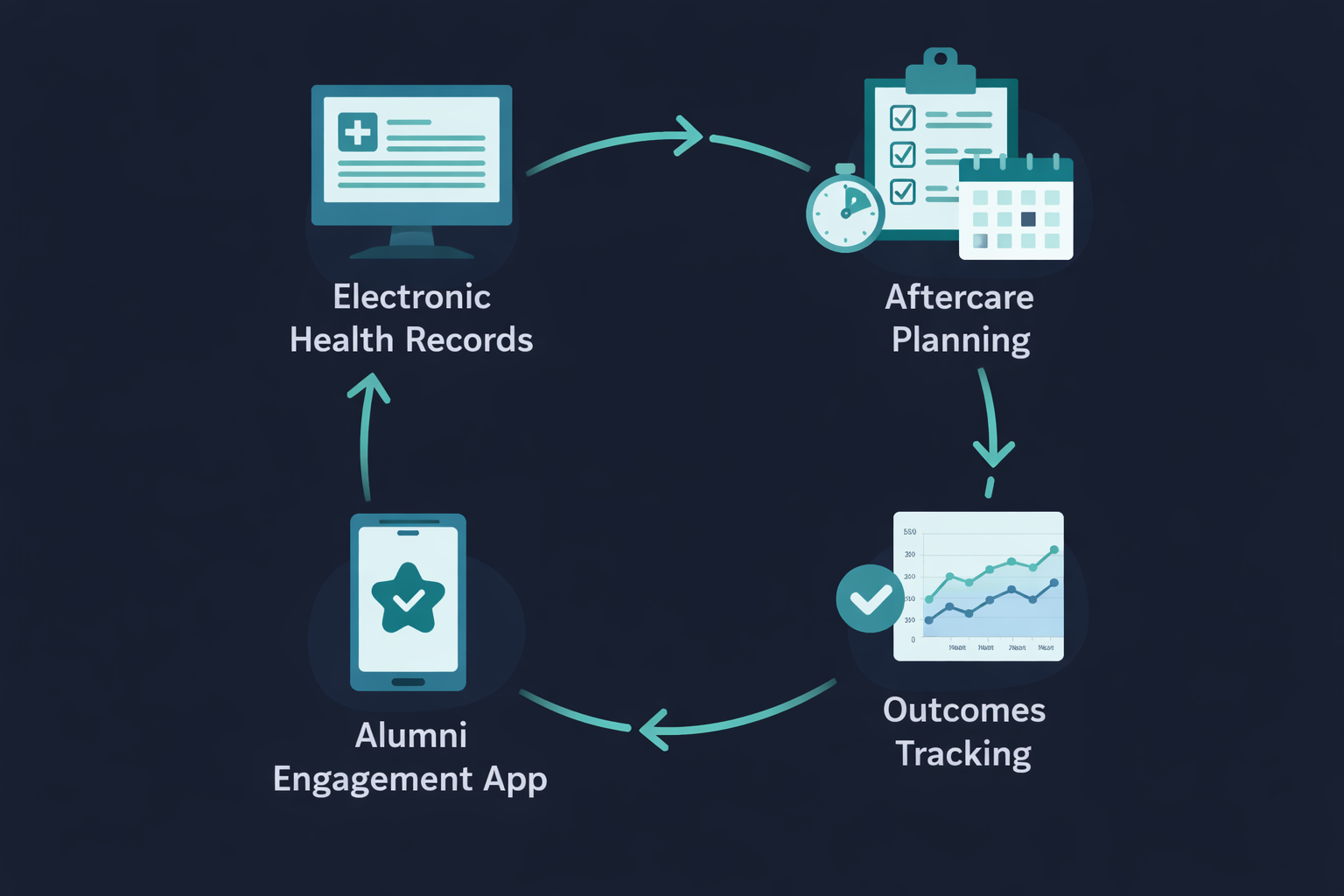
True integration means that data entered during treatment follows the patient into aftercare and alumni engagement automatically. A clinical note shouldn't live only in your EHR. A discharge summary shouldn't be an isolated document. An alumni check-in shouldn't feel disconnected from the care relationship built during treatment.
The key components of an integrated platform include:
- Electronic health records (EHR) for behavioral health. Purpose-built EHR that captures the nuanced documentation needs of addiction and mental health treatment, including ASAM criteria, group notes, and medication management
- Aftercare planning software. Tools that create structured, actionable aftercare plans during treatment and automatically trigger follow-up tasks post-discharge
- Treatment outcomes software. Standardized outcome measurement tools (like AUDIT, PHQ-9, or PROMIS) that track patient progress from admission through long-term recovery
- Alumni engagement platform. A mobile-first layer that keeps discharged patients connected to their community, their milestones, and your program
- Reporting and analytics. Dashboards that surface performance data for clinical leadership, billing staff, and compliance teams, all from one source of truth
Aftercare Planning Software: The Missing Link in Most Rehab Operations
Aftercare planning is one of the most evidence-supported practices in addiction recovery and one of the most inconsistently executed. When it's done well, it creates a bridge between the structure of treatment and the challenges of real life. When it's done poorly, it's a piece of paper handed to a patient at discharge that they never look at again.
Modern aftercare planning software changes the equation. It allows clinical teams to build individualized plans during treatment, assign tasks and referrals, set follow-up triggers, and hand off seamlessly to aftercare coordinators or alumni program staff.
When that aftercare plan lives inside the same platform as your alumni app, the continuity becomes real. A patient knows that the plan their counselor built with them is still accessible. And that someone is paying attention to how they're progressing against it.
Outcomes Tracking: Proving Your Program Works
In today’s landscape, outcomes are not optional but expected. Payers, accreditors, and regulators increasingly require behavioral health providers to demonstrate measurable, defensible clinical results. Anecdotal success stories and static spreadsheets no longer meet the standard. If you can’t clearly show what’s improving, for whom, and over what timeframe, you’re at a disadvantage, both clinically and financially.
Modern software for rehab centers changes that by building outcomes tracking directly into the care continuum. Instead of retroactively piecing together data, your program captures it in real time at every stage of the patient journey and turns it into actionable insight.
This includes:
Standardized, validated assessments at key milestones
Tools like PHQ-9, GAD-7, or substance use severity scales can be automatically administered at intake, throughout treatment, at discharge, and during long-term follow-up.
Longitudinal tracking beyond discharge
Recovery doesn’t end when a patient leaves your facility. Integrated alumni platforms allow you to track sobriety, engagement, relapse events, and quality-of-life indicators over months or years.
Real-time visibility for clinical teams
Clinicians and case managers can access up-to-date patient progress, flag risks early, and adjust treatment plans proactively, rather than waiting for issues to surface after discharge.
Population-level analytics that tell a bigger story
Dashboards and reporting tools aggregate your data across cohorts, programs, and timeframes, helping you identify trends, measure program effectiveness, and confidently report outcomes to stakeholders.
Stronger positioning with payers and partners
When your outcomes are clearly documented and easily shareable, you’re no longer just describing your value; you’re proving it. That opens the door to better contracts, stronger referral relationships, and increased credibility in a competitive market.
Software Integration in Rehab Workflows: A Practical Approach
Transitioning to an integrated system doesn't have to mean a complete overhaul overnight. The most effective approach is to audit your current software integration in rehab workflows and identify where the biggest gaps and handoff failures occur.
Common starting points include:
- Connecting your EHR to your alumni engagement platform so that discharge data automatically triggers follow-up workflows
- Replacing manual aftercare plan distribution with a digital tool that sends plans directly to custom mobile apps for treatment centers
- Building a single outcomes dashboard that aggregates data from across your clinical systems
At Team Recovery, our platform is capable of sitting alongside or integrating with your existing EHR. As attested by our clients, we focus on building the alumni engagement and outcomes layer that most EHR systems don't address well.
Conclusion
The most effective treatment centers think in systems. From intake to alumni engagement, every stage of the recovery journey is connected. And the right software for rehab centers makes that connection seamless, giving your team the tools to deliver better care, track real outcomes, and operate more efficiently.
When your technology supports the full continuum (e.g., clinical care, communication, and long-term engagement), you’re not just improving workflows. You’re strengthening patient relationships, increasing retention, and building a program that can prove its value in a competitive, outcomes-driven landscape.
Your treatment center deserves software that works as hard as your team does. At Team Recovery, we build integrated alumni engagement platforms that bring everything you need in one place. Book a demo today!

Henna Geronimo
Reviewer
Henna is a content strategist with over 5 years of experience. She specializes in creating informed, compassionate content for addiction treatment centers, using her deep understanding of the industry to educate, engage, and support individuals seeking recovery.
.webp)
.webp)