
.png)
You know your alumni program needs better technology. Your team knows it. Your clinical outcomes data probably confirms it. But before any investment gets approved, someone in your organization needs to answer one question: What is the return, and which behavioral health software solutions are actually worth the investment?
For many treatment centers, that question stops the conversation cold. Not because the ROI is not there, but because no one has built a clear model to demonstrate it. That is exactly what an ROI calculator is designed to do, and it is one of the most powerful tools available when making the business case for alumni engagement technology.
Here is how to use one effectively, what inputs matter most, and how to frame the results for the stakeholders who control your budget.
Why the ROI Conversation Matters for Behavioral Health Software Solutions
Alumni app investments often stall not because decision-makers disagree with the clinical case, but because no one has translated the clinical case into financial terms. Leadership teams in behavioral health are under real pressure to justify technology spending, especially in a reimbursement environment that continues to tighten.
The good news is that the financial case for addiction treatment software business case modeling is genuinely strong. Alumni engagement software reduces cost per acquisition by generating referrals, improves census stability by supporting re-admission prevention, and increases revenue by driving higher completion rates. The challenge is putting specific numbers to those outcomes.
That is where a purpose-built ROI calculator becomes essential.
The Key Inputs of a Behavioral Health Software ROI Model
A credible ROI model for behavioral health software solutions is built on a small number of high-impact variables. The most important ones to gather before you open a calculator are:
- Current alumni base size. How many graduates does your program have in its network, and how many new graduates do you add per year?
- Current alumni referral rate. What percentage of your current admissions come from alumni referrals? If you do not know this number, that alone is a reason to invest in tracking software.
- Average revenue per admission. What does a completed admission generate in net revenue for your program, accounting for your average length of stay and payer mix?
- Current cost per acquisition. What does it cost your program to acquire a new patient through paid channels including digital advertising, outreach staff, and marketing overhead?
- Current 90-day retention rate. What percentage of your alumni remain actively engaged with your program 90 days after discharge?
- Readmission rate. What percentage of alumni who re-engage with your program eventually return for a higher level of care?
With these inputs, a well-built ROI model can project the revenue impact of even a modest improvement in alumni engagement, referral activity, and retention. As many organizations evaluating technology investments have found, measuring ROI depends on connecting operational outcomes to financial outcomes rather than evaluating software cost in isolation.
What the Results Typically Show
Programs that run through a recovery support software ROI model are often surprised by the results. The reason is that alumni referrals are an extremely high-leverage channel. A single additional admission per month generated through alumni referrals, at an average revenue per admission of even a modest figure, quickly exceeds the annual cost of most alumni platform subscriptions.
Add to that the cost savings from reduced paid acquisition spend, the revenue impact of improved 90-day retention, and the downstream value of re-admissions driven by alumni engagement, and the case for the best alumni platform for addiction recovery becomes very difficult to argue against.
Our Growth Calculator is built specifically for this exercise. It takes your program's real inputs and models the projected impact of improved alumni engagement on admissions, referrals, and revenue. Run it before your next budget conversation, and explore our case studies page to see how alumni engagement technology and measurable ROI strategies have worked for treatment programs in practice.
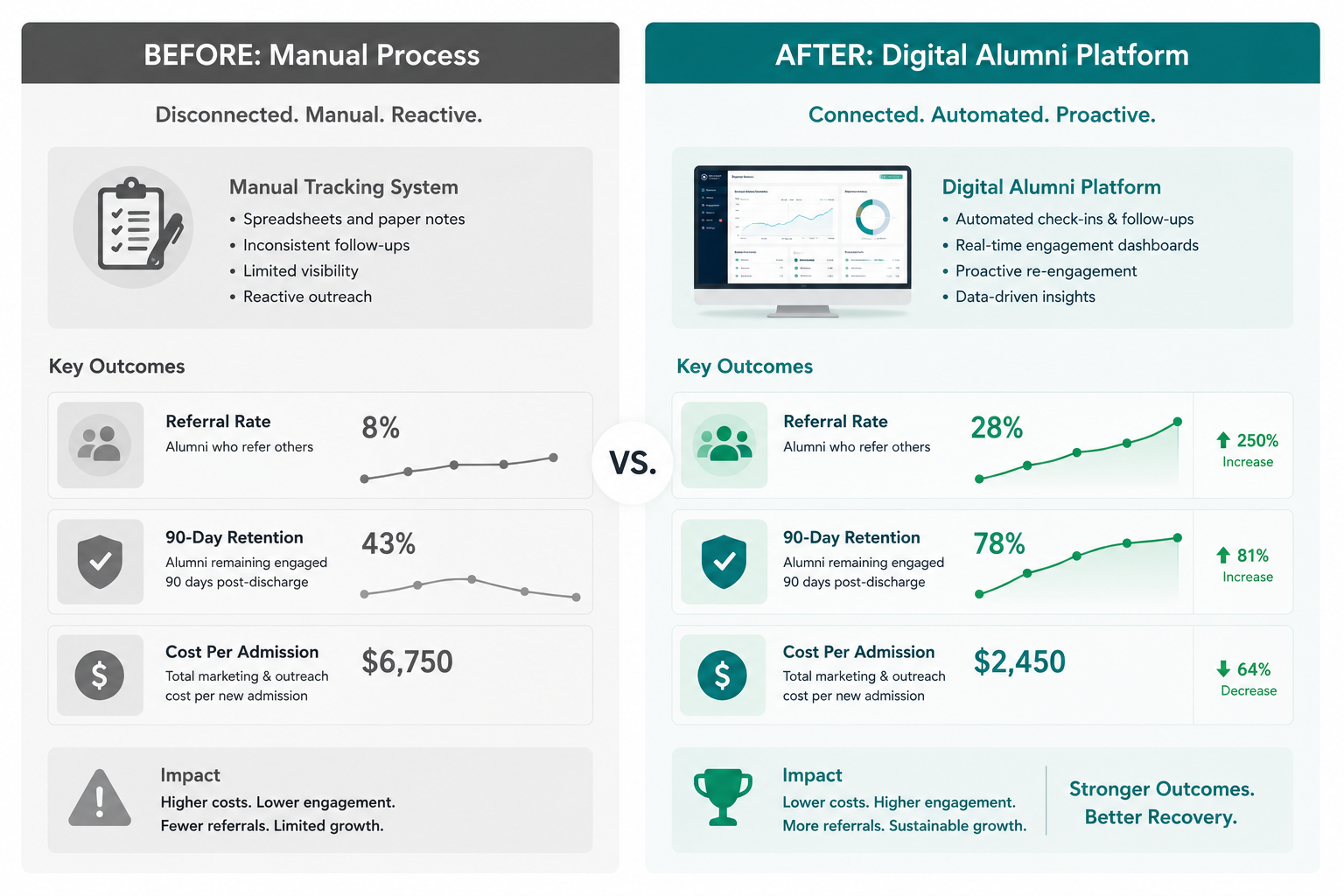
How to Frame the ROI Conversation for Different Stakeholders
Different stakeholders in your organization care about different parts of the ROI story. Presenting the right numbers to the right audience is as important as having the numbers in the first place. When evaluating behavioral health software solutions, decision-makers are rarely persuaded by a single metric alone. They want to understand how technology impacts financial performance, operational efficiency, clinical engagement, and long-term program growth from their own perspective.
- For executive leadership and ownership: Lead with net revenue impact. Show the projected increase in admissions from alumni referrals, the reduction in cost per acquisition, and the three-year cumulative value of a stronger alumni network.
- For clinical directors: Frame the investment in terms of outcomes. Improved 90-day engagement, earlier identification of at-risk alumni, and reduced readmission rates are all measurable clinical wins that also happen to support the financial case.
- For marketing and admissions directors: Show the cost per acquisition comparison. Alumni referrals consistently cost a fraction of what paid digital channels cost per conversion. Shifting even a small percentage of admissions to the referral channel has a significant impact on marketing efficiency.
- For compliance and IT leadership: Emphasize HIPAA compliance, data ownership, and integration capability. The behavioral health app investment only makes sense if the platform is built to the standards your program requires.
Beyond the Calculator: Building a Sustainable Case for Tech Recovery Solutions
A ROI calculator gets you into the room. What keeps you there is understanding how behavioral health software solutions create compounding value over time. An alumni platform does not generate returns once. As your alumni network grows and engagement becomes more consistent, the value compounds.
The programs seeing the strongest long-term ROI treat technology as a strategic asset, not a line item. They pair the platform with staff training, engagement strategy, and ongoing optimization.
For a closer look at how our platform supports these outcomes, explore our custom mobile apps overview.
And ultimately, the strongest ROI conversations are backed by more than assumptions. They are backed by clear projections, measurable outcomes, and a framework leadership can trust.
The ROI of your alumni app is real. The question is whether you have the model to prove it.
Team Recovery’s Growth Calculator is built to give you that model. Run it today and walk into your next budget conversation with numbers, not just intuition.

Henna Geronimo
Reviewer
Henna is a content strategist with over 5 years of experience. She specializes in creating informed, compassionate content for addiction treatment centers, using her deep understanding of the industry to educate, engage, and support individuals seeking recovery.
.webp)

.webp)